Automotive digital marketplaces act as intermediaries between car dealers and customers. They give buyers an extensive selection of cars across different years, models, and makes.
These marketplaces, whether for rentals or buying, face the nuanced challenge of balancing individual expectations against practical availability. It is a complex matching problem that calls for a sophisticated solution.
The Opportunity
AI/ML integration opens an avenue for value-added innovation and a transformed user experience through strategic integration.
Cars for you. CarFY, abbreviated.
An AI-powered agent for streamlining car discovery in Car-as-a-Service platforms, providing a personalized and enhanced user experience for customers.
0%+
Reduction in the time it takes a customer to find a car.
Recommendations that understand intent
Fine-tuned to each user’s specific motivation for needing a car, not just raw filters and specs.
Four goals shaped every turn of the conversation.
Fewer Turns to Completion
Every filter tweak and results scroll is another step between a user and a car. The dialogue is designed to compress that journey: from first utterance to a viable recommendation in the fewest possible turns.
A Spectrum of Intent Clarity
Some users arrive knowing the exact make and model. Others only know they need a car for a trip. The dialogue has to serve both ends of that spectrum without forcing one to behave like the other.
Recoverable Dialogue
Search dead-ends when nothing matches. A conversation never should. Every system turn leaves the user a way to refine, redirect, or recover, so no request ends at a wall.
Language as the Interface
Anyone who can describe a trip can use the system. Natural language lowers the barrier to entry: no product knowledge, no filter taxonomy, just a sentence about what you need.
Users approach car rentals with a wide range of preferences and constraints.
Budget considerations
Pricing significantly influences rental decisions, and customers weigh it heavily when sourcing a car.
Car preferences
Customers range from highly specific to completely flexible. Many seek particular features or precise make and model specifications.
A spectrum of motivation
Some individuals have crystal-clear transportation requirements; others are uncertain about their exact needs.
Compromise and abandonment
With limited options, many users settle for a lesser match, and some abandon the search altogether.
Many users end up compromising, selecting from limited available options. In some cases, they abandon the search entirely when no suitable match exists.
- →Customers factor in both budget and needs when sourcing a car.
- →They are mostly flexible with car preferences, given the nature of the marketplace.
- →They have the opportunity to easily compare different car models and prices.
UX Research Method
- Customer Feedback Analysis
- Reviewing customer feedback to identify recurring themes and areas for improvement.
- Customer Journey Mapping
- Visualising the experience from initial contact to post-purchase to surface friction points.
- Surveys & Questionnaires
- Structured surveys for quantitative data on customer satisfaction and preferences.
By shortening the time to find a car and ensuring recommended vehicles match what users actually need, rental rates rise and more searches convert.
Conversation Design Principle
Filters ask users to already know the answer. A prompt only asks them to describe the need, and the dialogue resolves the rest.
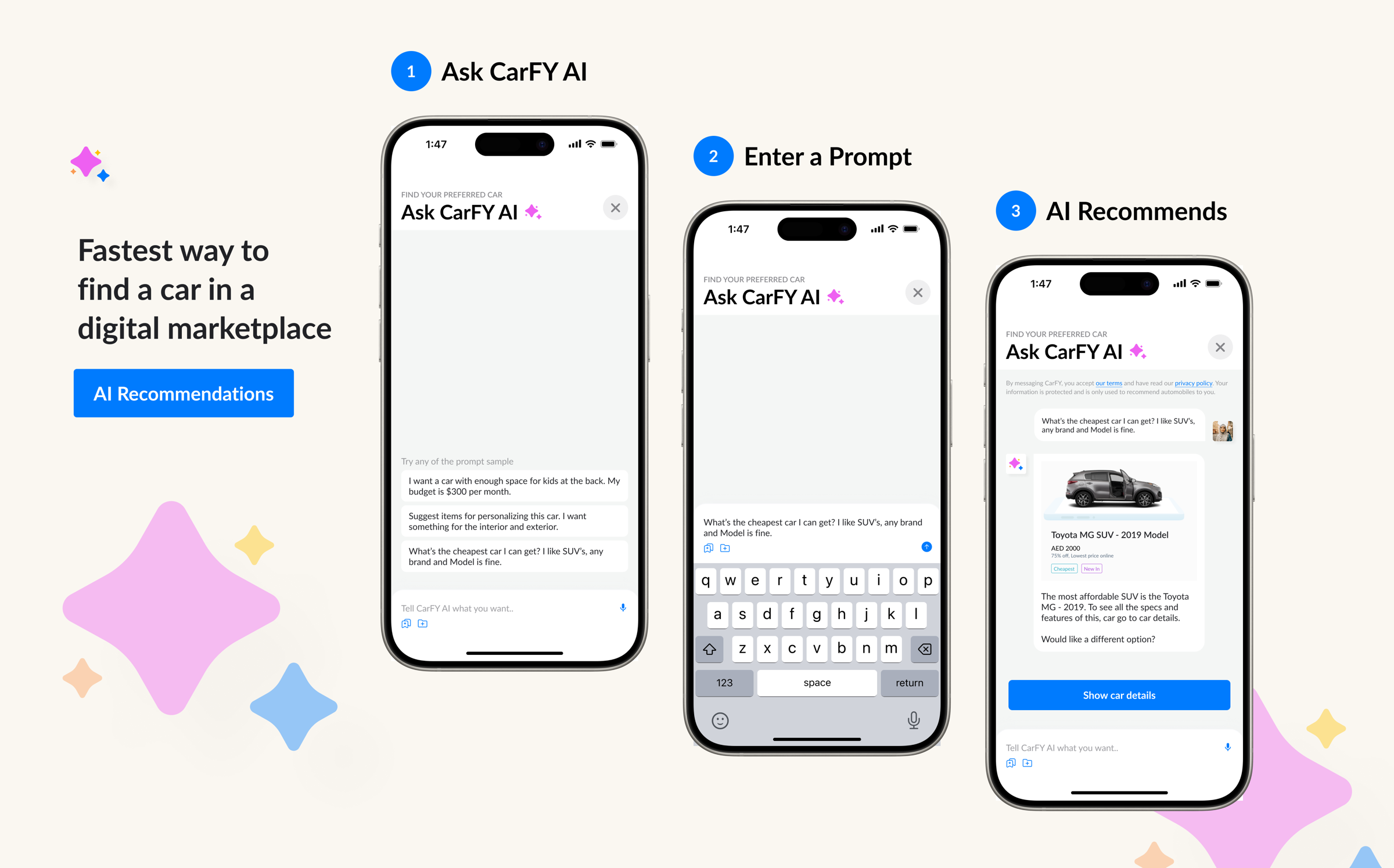
Three steps, one prompt: the user describes what they want in natural language, CarFY resolves that utterance into structured intent, and the answer comes back as a recommendation the user can act on.
The Dialogue in Practice
A single prompt is the happy path, not the only path. When intent arrives underspecified, the system asks rather than guesses. Here is one exchange, turn by turn.
Turn 1
Underspecified intent
“Something cheap for a family trip” gives a goal and a constraint, but no group size and no budget ceiling. Enough to start the dialogue, not enough to recommend.
Turn 2
A clarifying question
The system asks for the two missing slots, group size and budget, instead of guessing or dumping results. Asking is a repair move: it keeps the dialogue recoverable.
Turns 3 and 4
Intent resolved, reasoning shown
The user refines in plain language, no forms involved. The recommendation returns with its reasoning attached, so the user can judge the match rather than take it on faith.
Find your preferred car
Ask CarFY AI
By messaging CarFY, you accept our terms and have read our privacy policy. Your information is protected and is only used to recommend automobiles to you.
- How many people are travelling?
- What monthly budget works for you?
Toyota MG SUV - 2019 Model
AED 2000
75% off, Lowest price online
Five seats, kids friendly, and AED 2,000 a month keeps you under budget. The Toyota MG SUV is the strongest match for your trip.
Would you like a different option?
One utterance resolves into intent, entities, and an action.
Under the hood, CarFY does the three jobs every conversational AI system has to do: recognise what the user intends, extract the entities that constrain it, and decide what the system does next. Those mechanics were decided early, together with the responsible-AI commitments: protecting user privacy through the data collection process, and avoiding the reinforcement of bias during training.
Inside the Pipeline
A prompt never hits the catalog directly. The interpret step is intent recognition and entity extraction: the system works out what the user is trying to do, then pulls out the constraints that shape it. The tags it creates, Kids Friendly, Cheapest, SUV, are slot-filling output: structured values the recommendation can be filtered and ranked against. The final step is dialogue management: deciding how a single utterance resolves into a system action, in this case a recommendation the user can accept, refine, or dismiss.
User prompt
A request in natural language
Interpret prompt
Create tags
AI analysis of user context & bio data
Direct querying
Recommendation system
- Search database for makes and models
- Utilize tags for database search
- Combine different methods
Output
Toyota MG SUV - 2019 Model
AED 2000
75% off, Lowest price online
Role of AI
Personalized content and recommendations are areas where AI augmentation has proven effective. I’m using it to improve the digital experience of car sourcing in the Car-as-a-Service automotive sector.
Machine Learning
ML transforms raw data into meaningful, context-aware insights. It refines its performance through expanded data exposure, learning to digest complex information, recognise intricate patterns, and uncover critical anomalies.
ML techniques have been used by organisations like Netflix and Spotify to revolutionise user experiences, delivering hyper-personalized recommendations that feel intuitively crafted for individual preferences.
For CarFY, the ML algorithms represent a dynamic recommendation system that doesn’t just suggest. It understands, anticipates, and personalizes. By processing vast datasets and accessing car catalogs from diverse dealers, it can generate recommendations ranging from platform-wide suggestions to granular, customer-specific ones, becoming progressively more precise as it learns. This approach is anchored in robust ethical-AI frameworks, balancing technological potential with responsible implementation.
Trust comes from understanding the AI, and being able to control it.
To build trust in any AI system, users need to understand how the AI works and have flexible control over its output: to accept it, decline it, or ignore it.
Mental Models
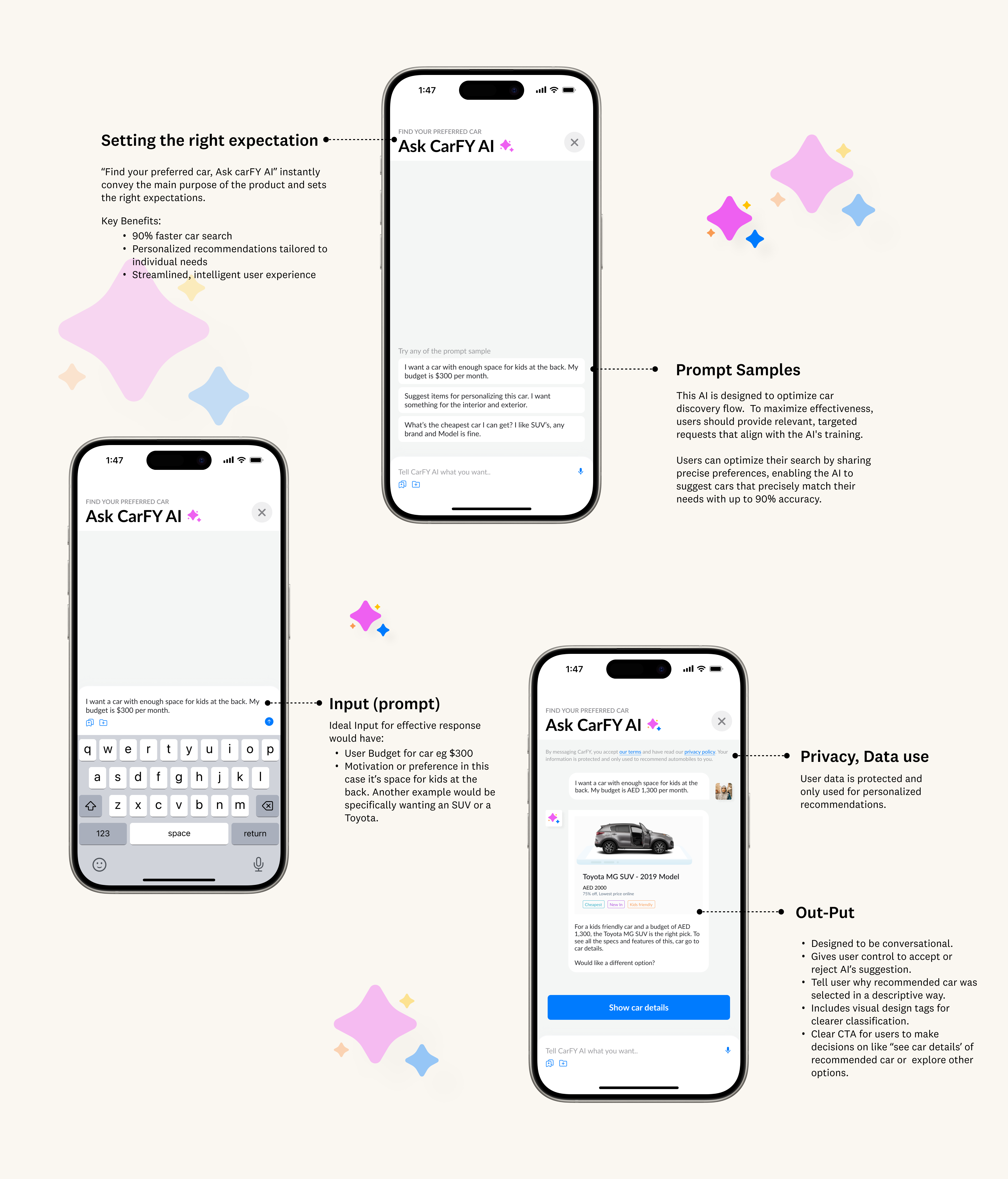
I’m leaning on the generative-AI interfaces customers already know, the chatbot pattern from tools like Claude and ChatGPT, to enhance the car-discovery flow. The interface is simple and direct, so I can explain what the AI will do and set the right expectations as users move through it.
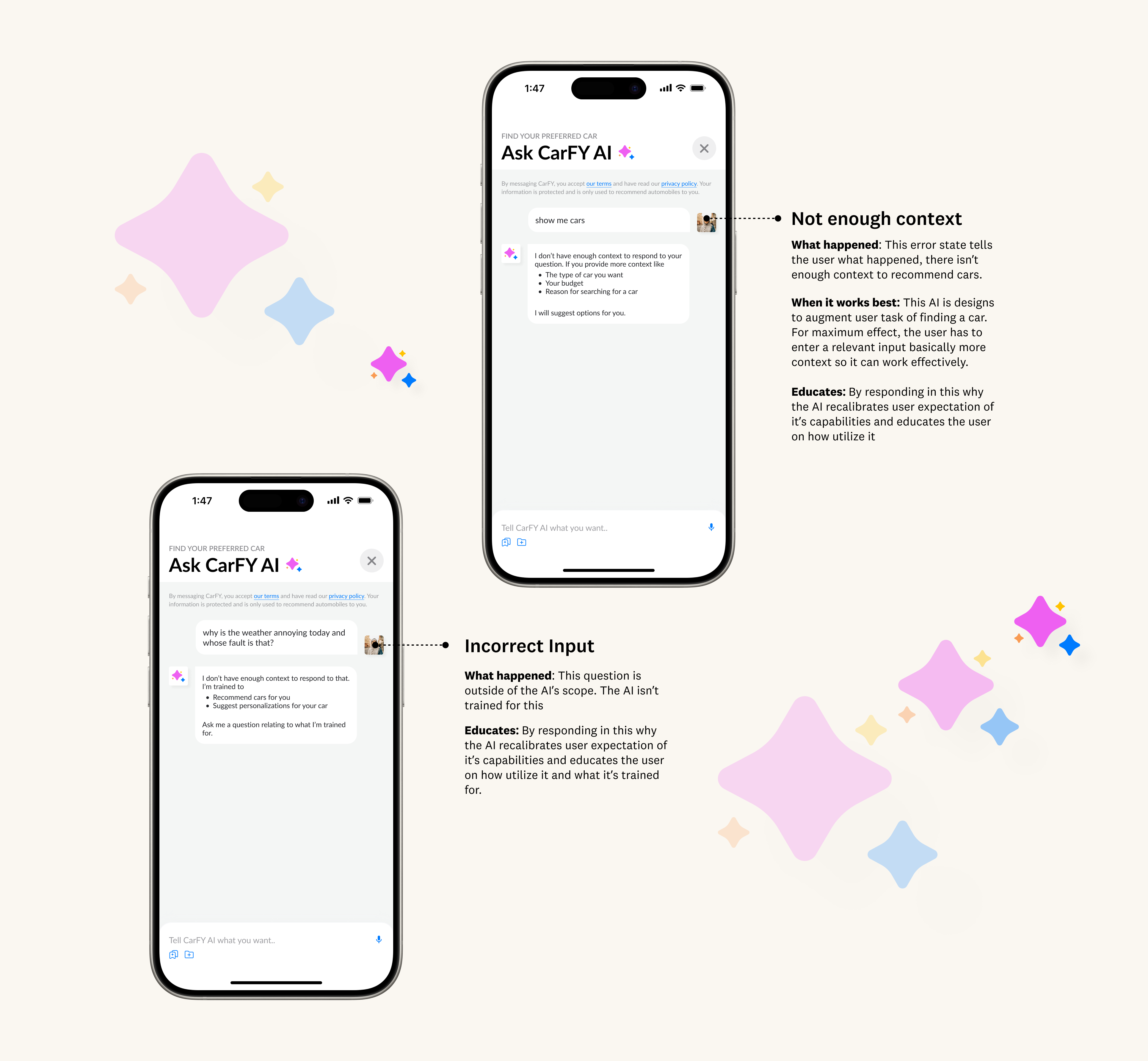
Conversation Repair
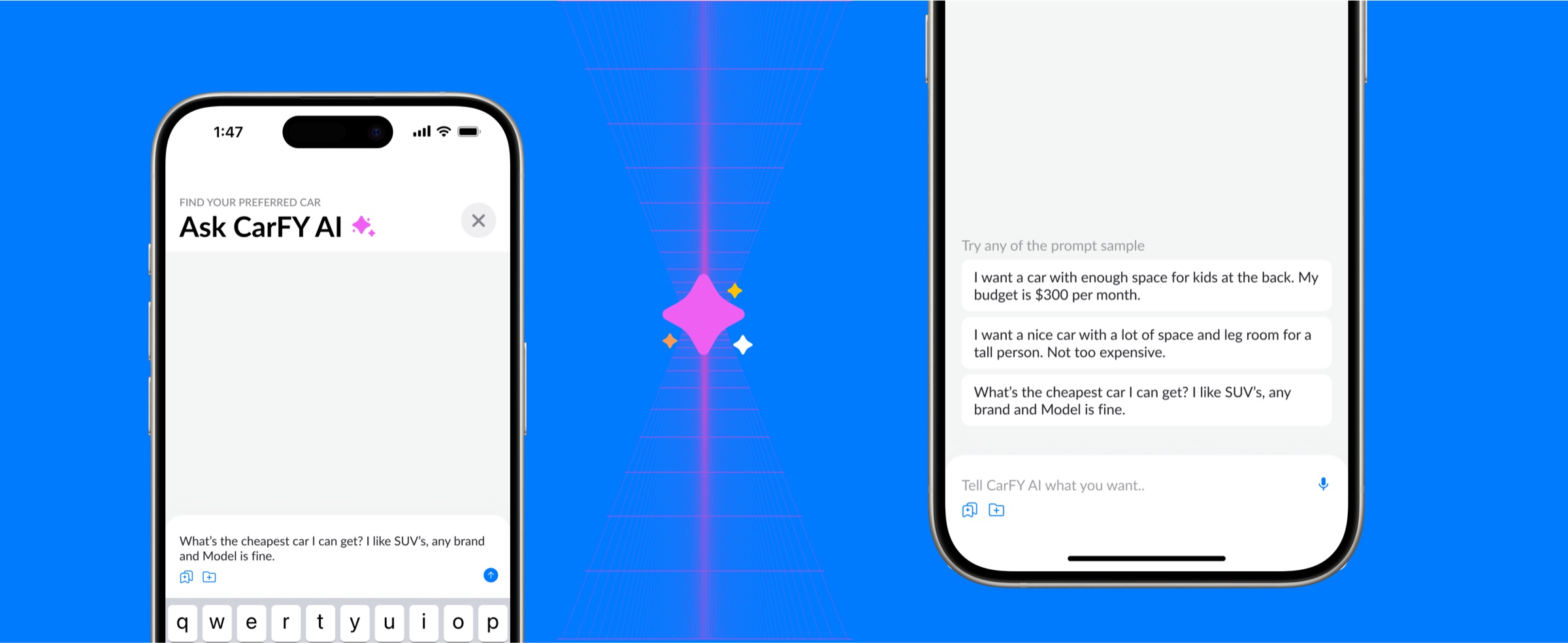
AI systems are probabilistic and never 100% correct. Conversational AI has a standard practice for the moment a turn fails: conversation repair, the design of responses that get a dialogue back on track. The feedback has to be clear and explanatory so users can recalibrate their expectations, steer the output, or ignore it. Errors can be opportunities to build trust. Because the stakes here are low, I focus on user errors and user-perceived errors. Two repair states cover most of them, not enough context and incorrect input, and each response is written to teach a stronger next turn.
Turn-taking, and staying in control
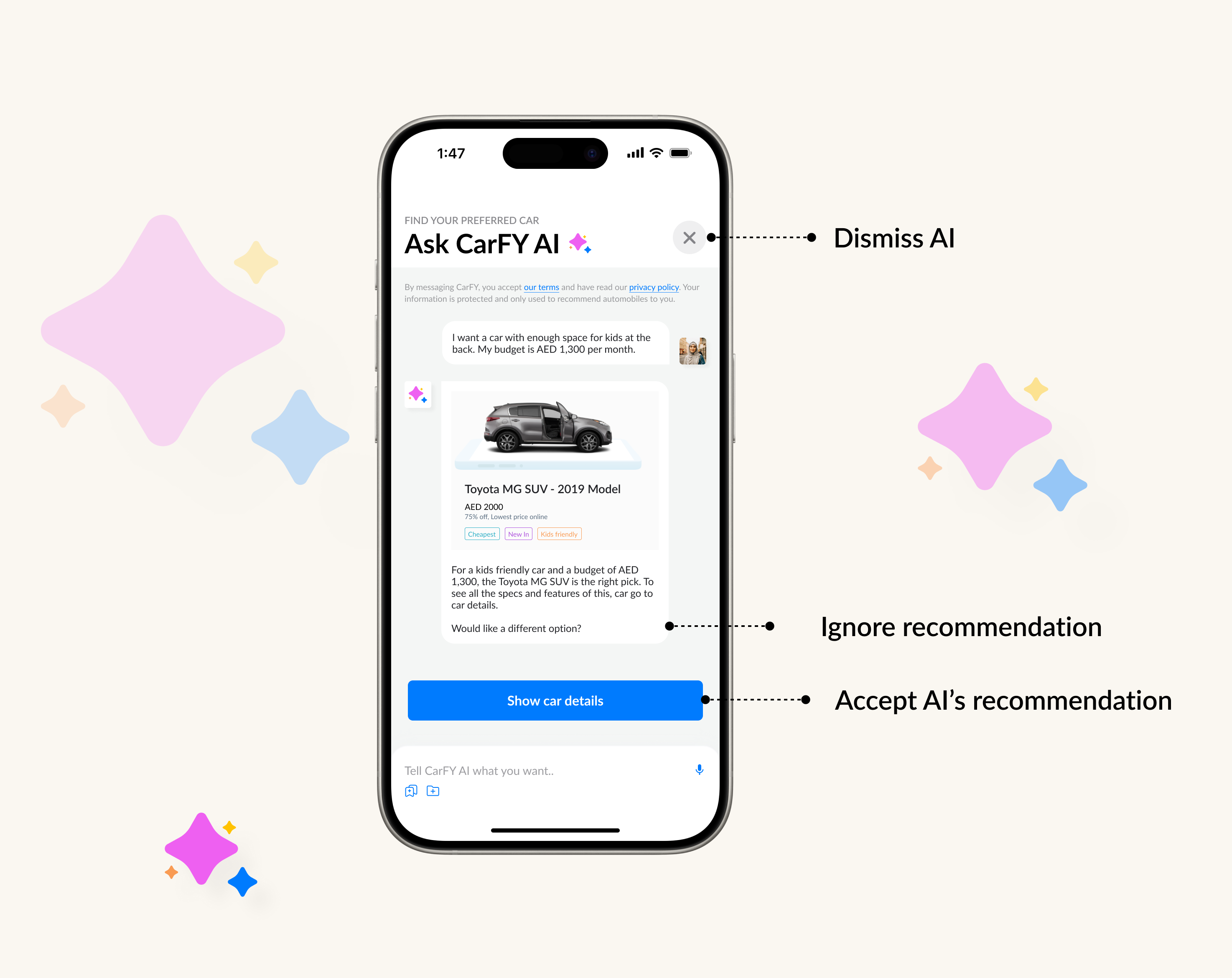
The recommendation reads like a reply, not a search result. It explains why this car fits the prompt, tags it for quick scanning, and always ends its turn by handing control back. That handover is turn-taking design: every suggestion closes with three moves the user can make, so one-shot output becomes multi-turn control and no recommendation is a dead end.
Accept the recommendation
“Show car details” opens the full specs and moves the user forward.
Ignore it, ask for another
“Would like a different option?” keeps the conversation open, no dead end.
Dismiss the assistant
The close control hands the user straight back to normal browsing.